
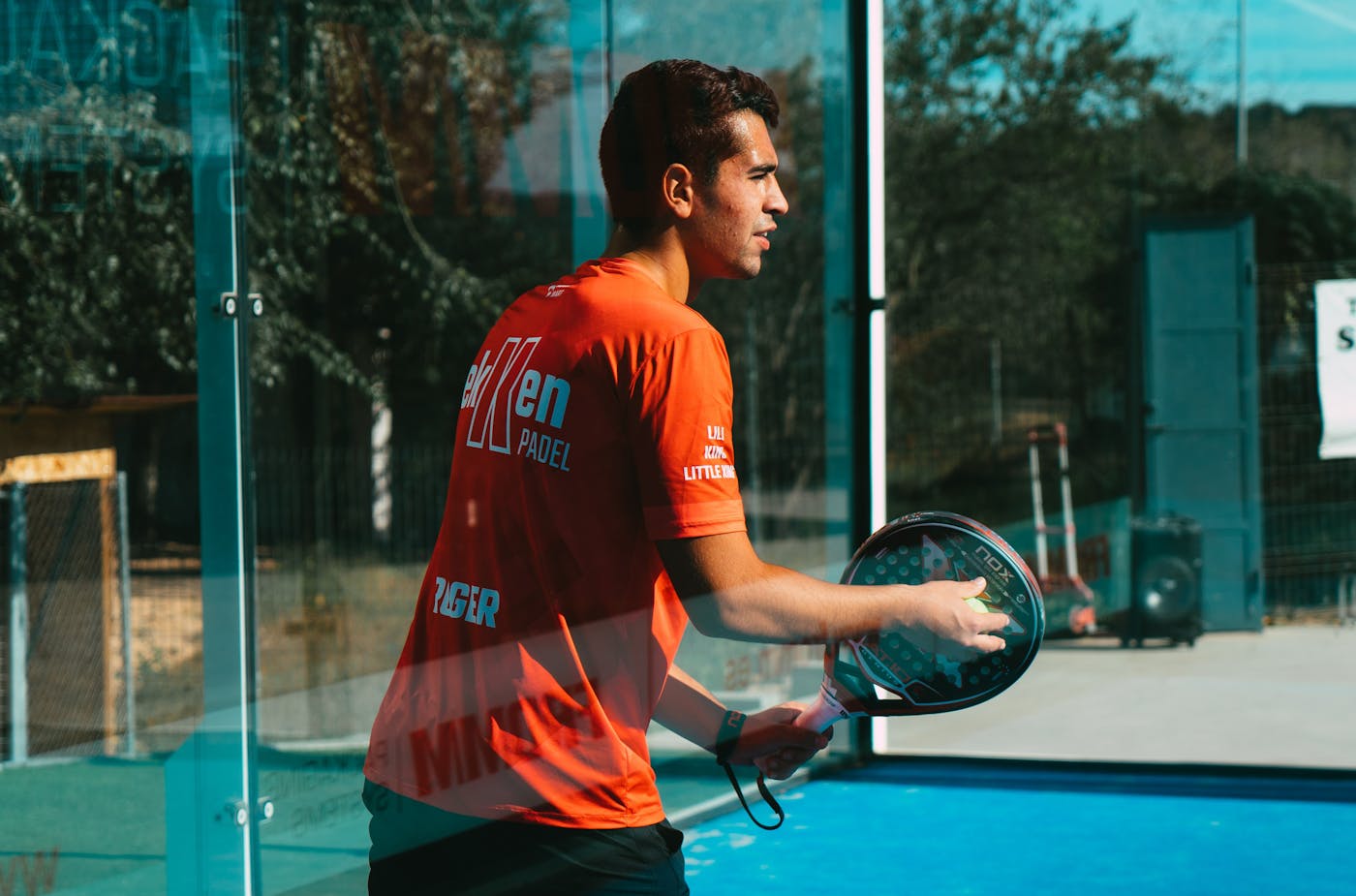
If opponents keep directing the ball to your partner, do not try to force your way into the rally or demand an equal share of shots. First check that it is a real pattern; then agree one safe way to change the rally and one clear job for each player. Players sometimes call this informal tactic “the fridge” or nevera: one opponent is involved repeatedly while their partner gets fewer balls.
The aim is not to make every point go through both of you. It is to stop the pattern dictating your pair’s positioning, confidence and shot choices. This Notice–Shape–Support–Review plan applies LTA Padel’s guidance on consistency, court positioning, lobs and partner communication to that specific match situation.
1. Notice the pattern before changing your game
One quiet rally does not prove that your opponents are deliberately targeting anyone. The ball may simply be travelling cross-court, your partner may be holding a more inviting position, or you may both be recovering unevenly. Look for the same choice being made in similar situations over several rallies.
Ask a simple question during a natural pause: Are they choosing my partner even when another safe option is available? You do not need a tally or a debate. If the answer is unclear, keep playing your normal game and observe another few points. Avoid labelling a partner as “the weak player”; that adds pressure without telling either of you what to do next.
2. Shape the next ball instead of forcing a winner
The player receiving most of the balls has the first shot, but does not have to solve the whole tactic alone. Pick the highest-margin reply available from your position and balance.
| Situation | Useful first option | Avoid |
|---|---|---|
| Both opponents are established at the net and you have time to set up | Use a controlled lob if you can send it high and deep enough to make them turn; move forward together only if the ball gives you time. | Trying to blast through two set net players from a defensive position. |
| You are balanced and both opponents leave a central gap | A controlled ball through the middle can create uncertainty about who takes it and help your pair anticipate the reply. | Treating every middle ball as an automatic winner or hitting it without checking their positions. |
| You are stretched, late or close to the back glass | Prioritise a safe return and recover with your partner; look for a better opportunity on the next ball. | Attempting a low-percentage angle just to make the other opponent touch the ball. |
LTA Padel describes the middle as a relatively safe target that can make opponents hesitate, and explains that a lob can give a pair time to move towards the net. Those are options, not commands: the right choice still depends on the ball, your balance and the opponents’ positions. For a step-by-step look at one of those options, see our guide to practising a deep padel lob.
3. Give the less-involved partner a useful job
If the ball is going to your partner, do not cross into their hitting lane just to get a touch. Stay ready for a short reply, a ball through the middle or a change of direction. Keep enough distance to cover your own side while staying connected as a pair.
Use one practical call when it helps: “I have the middle,” “stay with me,” or “we move together.” LTA Padel recommends clear “mine” and “yours” calls and useful positioning information, as well as building a partner’s confidence rather than criticising mistakes. A calm cue can help; a running commentary usually cannot.
If you are repeatedly unsure who should take a central ball, agree a default outside the rally and use the middle-ball decision guide to refine it. The partner who has fewer shots may still influence the point through position, communication and readiness.
4. Agree one experiment, then review it
At a natural pause, try one adjustment for the next few rallies—for example, “If they stay at the net, we use the lob when it is comfortable and move together.” Keep the cue specific enough that both players know what to do. Then check whether it changed the rally or merely created a new problem.
This is not a reason to switch sides mid-set or abandon a formation that is working. British No. 1 Christian Medina Murphy’s LTA Padel interview stresses adapting tactics to the players and conditions rather than relying on one favourite tactic; he also describes asking a partner for a specific kind of cover when under pressure. If you need a longer discussion, save it for a suitable changeover. Our between-points reset checklist can help keep the next-point cue brief.
After the match, note just one example: what shot or position started the pattern, what response you tried, and what happened next. That is more useful than a general note that one player “got frozen out.” See what to track after every padel match for a simple way to turn a repeated match problem into a training focus.
A partner drill for practising the response
Use this as a practice idea, not a formal or proven training protocol:
- Start a cooperative rally with one player receiving most of the feeds.
- That player works on a controlled reply—using a lob only when it is a sensible option—while their partner maintains a useful covering position and communicates clearly.
- Repeat with the other player receiving most of the feeds, then play points where both pairs can choose freely.
- After each block, name one thing that helped the pair stay organised and one adjustment to try next.
The drill is about making a decision together, not manufacturing a winner or proving that a particular tactic always works. If you record a match, a short clip can help you review whether the targeting pattern really repeats and how the pair responds. Padel Coach App is one option for turning a recorded rally into a focused question for your next practice; read how to record padel video for analysis before filming, and make sure everyone involved is comfortable being recorded.
Sources and scope
- LTA Padel: Padel match tactics for beginners — guidance on consistency, middle-ball choices, the lob, positioning and partner communication.
- LTA Padel: advice from British No. 1 Christian Medina Murphy — interview advice on adapting tactics, partner cover and supportive communication.
“Fridge” and nevera are informal player terms, not the name of a special scoring rule. The framework and drill above are editorial suggestions based on the cited guidance; they are not official LTA or FIP instructions and cannot guarantee a result.
Learn how our guides are researched, prepared and checked in our editorial policy.