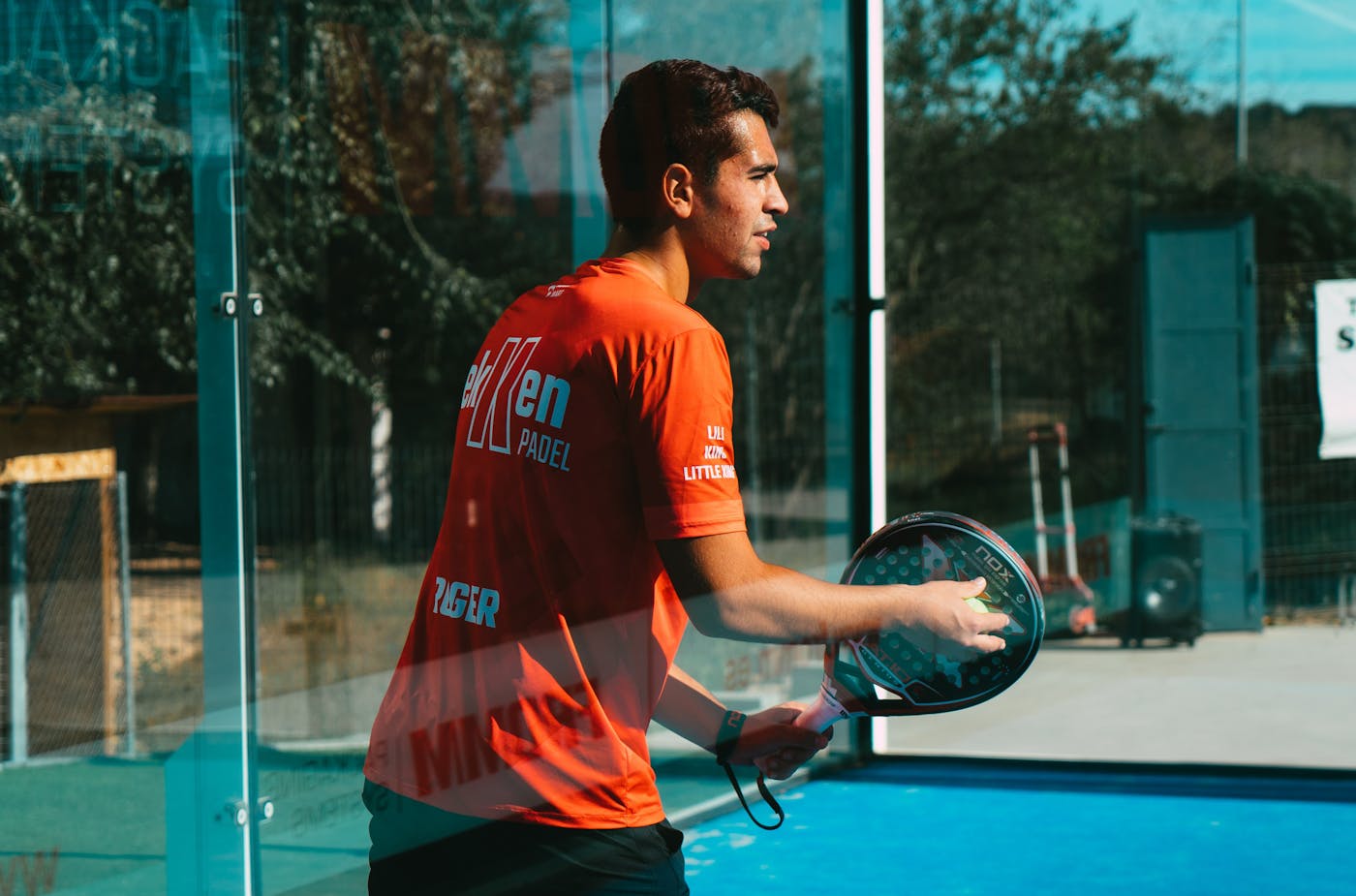
If both partners make contact with the ball, their pair loses the point—even if the contacts are almost simultaneous. There is one narrow distinction: if one player hits the ball and their partner’s racket hits that player’s racket, the International Padel Federation (FIP) says that is not a double hit. If the ball remains live and the return is otherwise legal, play on.
This guide is for doubles pairs and coaches who need to settle a collision at the net or in the middle of the court. It explains the racket-contact rule, not which partner should normally take the shot; for that decision, see our middle-ball guide.
What did each racket touch?
Start with the contact, not how loud the clash sounded or whether both players meant to play the ball. The 2026 FIP rules separate a double ball contact from the specific case where one partner hits the ball and the other hits their teammate’s racket.
| What happened | Ruling | Rule basis |
|---|---|---|
| Both partners’ rackets contact the ball, at the same time or one after the other | The pair loses the point. | FIP Rule 13.1(o) |
| One partner contacts the ball; the other partner’s racket hits their teammate’s racket | The FIP note says this is not a double hit. The clash alone does not end the rally; the return must still be legal and the ball remain in play. | Note to FIP Rule 13.1(o) |
The practical check is simple: did both rackets touch the ball, or did one touch the ball and the other touch a racket? A collision alone does not tell you which happened.
Example: your partner hits your racket during a volley
Imagine both players step towards a chest-height ball. Your racket makes the return, then your partner’s racket clips yours as the two swings cross. If the partner did not also contact the ball, the specific FIP note says the racket clash is not a double hit. The point does not end for that reason alone.
Change one detail: your partner’s racket also contacts the ball, either at the same moment as yours or just afterwards. Now both partners have hit the ball, so Rule 13.1(o) says the pair loses the point.
LTA Padel’s beginner rules summary gives the useful short version: both partners cannot hit the same return. The FIP note adds the detail for a racket-to-racket clash when only one player hits the ball. That narrow note is not permission for both players to touch the ball.
How to make the call during a match
Use this order to avoid turning a close rally into a debate about intention:
- Was the ball still live? If the point had already ended, a later collision cannot change the ruling.
- How many ball contacts were there? If both partners contacted the ball, Rule 13.1(o) applies.
- Was the second contact racket-to-racket instead? If one partner hit the ball and the other hit their racket, the FIP note says it is not a double hit.
The rules determine the ruling; they do not make a disputed fact visible. If nobody can tell whether the second racket touched the ball or only the other racket, do not claim certainty. In a friendly game, agree a fair call and move on. In a competition, ask the umpire or follow the event’s dispute procedure.
Prevent the collision before the swing
The exception is useful for settling a point, but good spacing is better than relying on it. Agree a quick “mine” or “yours” call, make it before the swing, and let the non-hitter clear the hitting lane. Our padel positioning basics covers how partners adjust their shape, while the beginner volley-control drill can be adapted with a partner call before each feed.
For a simple progression, start with comfortable feeds through the middle. One player calls and volleys; the other stays clear and prepares for the next shot. Then vary the feed and let the pair decide who takes it. The return and first-volley drill is another useful place to practise a clear transition call without rushing into the same space.
Can video settle a racket-clash call?
A clip may help you see the players’ positions and whether the pair communicated, but a distant or obstructed camera may not show which racket touched the ball. Treat the visible footage as evidence, not a guaranteed ruling. Padel Coach App can help you review a repeated positioning or communication problem after a session; it does not replace the rules or an umpire’s decision. You can learn more about the app on the download page.
Official sources
- International Padel Federation: Rules of Padel, reviewed for application from 1 January 2026 — Rule 13.1(o) and its accompanying note.
- LTA Padel: official padel rules — player-facing summary of the rule that partners cannot both hit the same return.
Learn how our guides are researched, prepared and checked in our editorial policy.