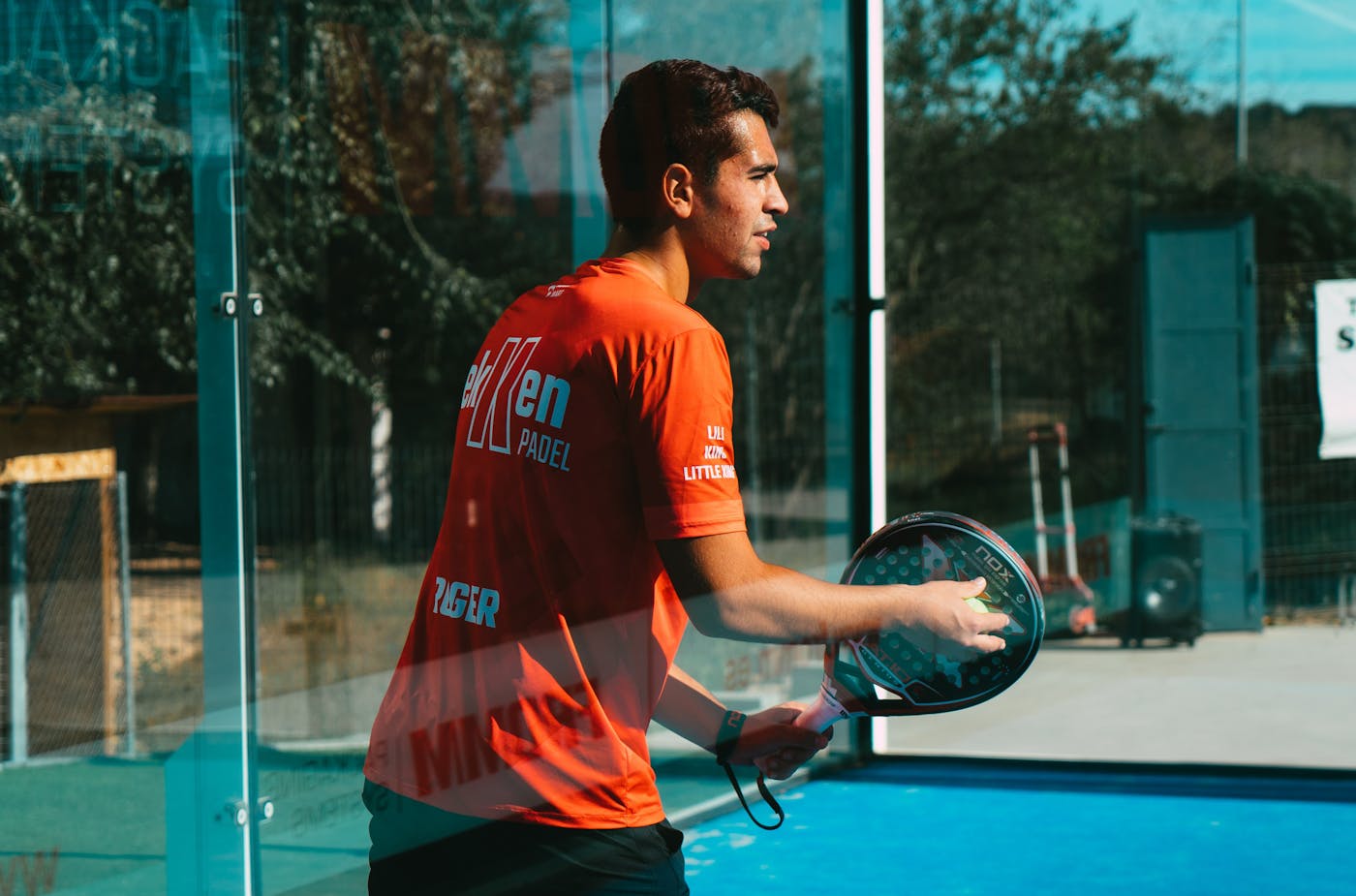
The most reliable way to return a padel serve and reach the net is to buy time first, then move behind the return. Do not sprint forward automatically. Let the serve bounce, read the height and depth, choose a margin that makes the server’s next ball harder, and move as soon as your return has given you time.
This guide is for improving players who often hit a perfectly legal return but lose the point while trying to transition. The fix is usually not a faster first step. It is a better match between the return, the available time, and your pair’s movement.
What does the serve-return rule allow?
Under the 2026 FIP Rules of Padel, the receiver must allow the serve to bounce in the receiving service box before returning it. You must play it before it bounces a second time. A serve can then reach the glass or cage during the rally, so the receiver may also choose to play the ball after a rebound if there is still time.
That rule creates a useful pause. You are not allowed to volley the serve, but you are allowed to use the bounce to read the ball. The return decision begins with the first bounce, not with the server’s racket swing.
For a refresher on service boxes, lets, fence faults and receiving order, see padel serve rules explained.
What is the quickest return decision?
Use the bounce–balance–build check:
- Bounce: Where did the ball land, and is it travelling towards the side glass, your body, or the middle?
- Balance: Can you contact it in front while stable, or are you low, late, turning, or close to the wall?
- Build: Which return gives your pair time to move forward and prepare for the next ball?
The third question stops “get to the net” becoming a blind command. A return can be technically clean and still be a poor transition ball if it leaves the server with a comfortable volley.
Which return should you choose?
| What the serve gives you | Return with | Why it works | Net movement |
|---|---|---|---|
| A high or slower bounce with space to set | High cross-court lob | Gives the server a longer ball to manage and can push the pair away from the net | Move forward behind the lob, but keep enough space to react to the overhead |
| A comfortable waist-to-chest contact in front | Controlled cross-court drive | Uses the open diagonal and makes the server play from behind the service line | Start forward as the ball travels; split-step before the next contact |
| A central, manageable serve | Firm ball through the middle | Removes a sharp angle and makes the server pair decide who takes the ball | Move together, protecting the middle rather than chasing the sideline |
| A low, late ball or a ball tight to the glass | High-margin return or glass reset | Keeps the point alive when attacking contact is unavailable | Delay the sprint; recover your balance before advancing |
| A short serve that sits up | More purposeful drive to a corner or body | Applies pressure while the server is still recovering from the serve | Move with intent, but only after the racket has finished the return |
These are choices, not rigid shot labels. A lob is not automatically defensive, and a drive is not automatically aggressive. The useful question is whether the ball you hit changes the time and space available to the serving pair.
When should you lob the serve?
Lob when the bounce gives you time to get underneath the ball and send it high enough to make the server’s next contact difficult. Aim for height and depth before trying to paint the back corner. A lob that lands safely deep but gives you time to move is often more valuable than a lower lob that leaves you stranded halfway up the court.
The LTA Padel serving guide emphasises placement and the server’s goal of reaching the net. Your return should therefore be judged by the transition it creates, not just by whether it clears the net. If the lob is short, keep moving with your partner and prepare for the overhead rather than assuming the net is already won.
Call the lob early if your partner needs to move with you. A simple “high” or “lob” is more useful than silence followed by a sprint.
When is a drive or middle return better?
Drive when you can contact the ball in front with control. Cross-court gives you a longer diagonal and often more margin over the net. Through the middle can be useful when the serving pair is split or when a side angle would give the server’s partner an easy volley.
Do not choose the middle merely because it feels safe. Look at the pair’s spacing. If both servers are close together, a middle ball can create indecision. If they are already covering the middle, the cross-court lane may be the clearer target.
The LTA’s beginner guidance also stresses accuracy, short preparation and reading the incoming ball rather than chasing power. That supports a simple practice rule: reduce the swing before you reduce your target. Keep the return compact enough that you can recover after contact.
Should you use the glass on a serve return?
Use the glass when the serve has travelled deep enough that taking it early would crowd your contact or force you to hit while moving backwards. Turn early, create space, and allow the rebound to bring the ball into a more playable zone. Do not wait passively against the wall; the back-glass guide explains the movement pattern as turn, move, wait, hit.
The glass is a reset, not a default. If the serve is short and comfortable, playing it before the wall usually gives you more time to move forward. If the ball is low and close to the glass, a high-margin return is often wiser than a rushed attack.
When should you move forward?
Move when your return has started to travel and you can see the likely next contact. Your first steps should follow the ball, not outrun it.
Use this sequence:
- Finish the return with your body balanced enough to move.
- Take the first step in the direction that keeps you and your partner connected.
- Read whether the server’s partner is volleying, letting the ball bounce, or preparing an overhead.
- Split-step as the opponents make contact.
- Continue forward only if the next ball remains manageable.
If the return is low, late or immediately attacked, stop the forward movement and defend together. A halfway position with no split-step is usually worse than choosing the back of the court early. The broader padel positioning guide explains why pairs should adjust as a unit rather than treating the returner’s movement as a solo race.
Worked example: a wide serve to the backhand
Imagine a right-handed player receiving from the right side. The serve lands deep towards the backhand corner and reaches the glass with enough pace that an early contact would be cramped.
- Bounce: The first bounce is deep and the ball is moving towards the glass.
- Balance: The player is turning and moving; contact in front is not available yet.
- Build: A controlled glass return with height gives the pair time to defend or reset.
The correct choice is not to force a low cross-court drive because that was the plan before the serve. The receiver turns, lets the ball rebound, plays high cross-court with margin, and moves with the partner once the ball is travelling. If the rebound instead dies short enough for a balanced contact, the player can take it before the glass and begin the transition earlier.
The decision is visible on video: compare the player’s position at the first bounce, the contact distance from the glass, and whether both partners moved after the ball was struck.
How can you practise the return and the net move together?
Use the existing return and first volley drill, but add a decision score instead of feeding the same serve every time.
Stage 1: one predictable serve
Feed ten serves to one receiving side. The returner calls “drive”, “lob” or “glass” after the bounce, then plays with a large target. Score one point for a sensible choice and one for a return that allows a balanced first step.
Stage 2: mix the depth
Mix short, medium and deep serves without announcing them. The returner must use the bounce–balance–build check and the server pair plays the next ball. Score the decision, not whether the return wins the point.
Stage 3: make the transition real
The serving pair tries to pressure the first volley. The receiving pair earns the point only if both players reach a connected position and split-step before the next contact. A good return that forces an immediate retreat still counts as a good decision; the aim is to recognise the next ball honestly.
Record from behind the receiver. Afterward, use AI video analysis for padel or your own notes to tag three things: choice after the bounce, balance at contact, and movement after the return. Padel Coach App can help keep those clips and practice notes together; use it to identify one repeated transition cue, not to replace a coach’s judgement.
What should you remember in a match?
Use this short checklist before the next return:
- Let the serve bounce and read its depth.
- Choose the return that matches your balance.
- Prefer height or the middle when the angle is disappearing.
- Move behind the ball, not ahead of it.
- Split-step before the opponents’ next contact.
- If the return leaves you late, defend as a pair instead of stopping halfway.
The goal is not to reach the net after every return. The goal is to make the next ball playable from a better position. When you review a match, log whether the return created time, whether the pair moved together, and whether the first volley was prepared. You can keep those observations in the Padel Coach App download workflow alongside the video that produced them.
Sources
- International Padel Federation: Rules of Padel
- LTA Padel: Expert tips on how to serve
- LTA Padel: Skills for beginners
Learn how our guides are researched, prepared and checked in our editorial policy.