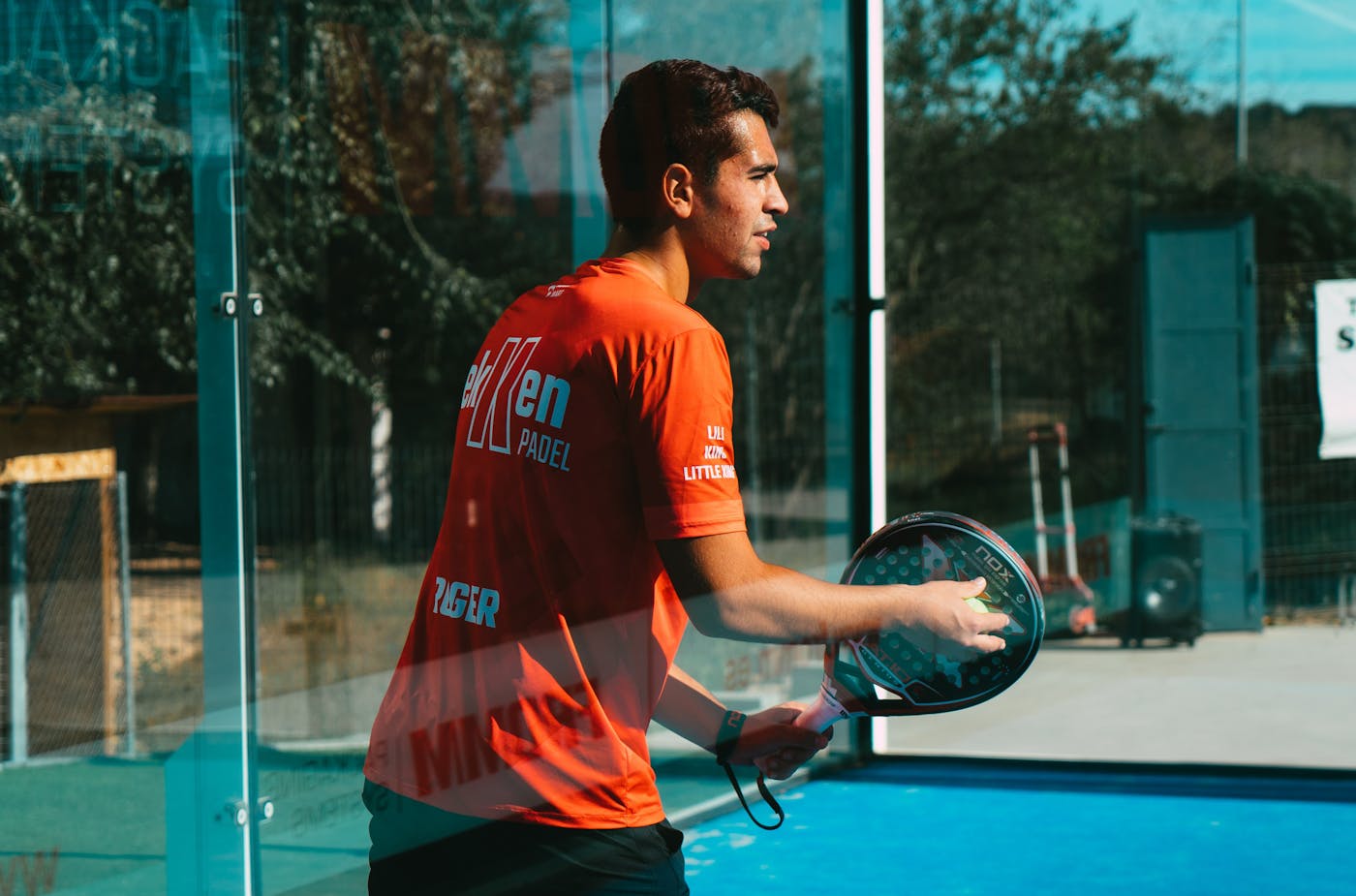
When it is windy, do not try to change every shot at once. Use the warm-up to see whether a ball carries, falls short or drifts sideways from each end, then make one small target adjustment and check it again after you change ends. Wind affects the flight most visibly on higher, longer shots, but the air inside an outdoor court may not behave exactly like it does outside the enclosure.
This guide is for recreational and improving players who play outdoors and want a simple match-day plan. It is not a technical wind test: treat each observation as a starting cue, not a formula that guarantees where the next ball will land.
Start with a quick court-side wind check
Use the warm-up to compare similar, comfortable shots from each end. A medium-height ball through a broad central target is enough; you do not need to hit hard or aim for a line. Notice where it lands relative to where you intended it to go.
| What you notice | First adjustment to try | Check on the next ball |
|---|---|---|
| A ball hit into the wind keeps falling short | Choose a deeper safe target, while keeping enough height to clear the net. | Did it travel farther without forcing a rushed swing? |
| A ball hit with the wind carries farther than expected | Aim shorter and leave room before the back glass or baseline. | Did the ball land in a playable area rather than running long? |
| The ball repeatedly drifts sideways | Begin with a broad central lane. If the drift is consistent, shade the aim slightly into the wind. | Is the sideways movement repeatable, or was that just one gust? |
| The flight changes from rally to rally | Use more margin and avoid building a point around a narrow target. | Has the wind settled, or should you simplify again? |
“Into the wind” means the ball is travelling against it; “with the wind” means it is travelling in the same direction. A crosswind moves across the ball’s path. The labels help you describe what you see, but the ball’s actual flight matters more than an outside weather app or a guess based on flags beyond the court.
The key is to change one thing at a time. If a lob lands short, for example, first adjust the intended depth; do not simultaneously add a bigger swing, more height and a new direction. A single change makes it easier to tell whether the adjustment helped.
How should you adapt your shots?
Keep the lob, but reassess its depth
The lob is still useful in wind. LTA Padel describes it as a way to move opponents back, create time and help a pair improve its position. Its regular practice target—beyond the service line and before the back glass—is a useful reference in settled conditions, not a fixed target for every gust.
If the ball is shortening into the wind, aim for a deeper safe area rather than simply adding height. If it is carrying with the wind, bring the target forward and leave a bigger margin from the glass. Keep the decision connected to the incoming ball: when you are stretched or late, a controlled rally ball may be safer than forcing a high lob. Use the four-stage deep-lob progression when you want to practise height and depth separately.
Choose control over a forced overhead
Wind can make a high ball harder to judge, so do not treat every overhead as a chance to hit through the conditions. If you are balanced and the contact suits it, a controlled overhead may help your pair keep its position. LTA Padel presents the bandeja as a control-focused option for retaining the net, while a smash is the more aggressive choice.
If the ball has pushed you off balance, lower the risk instead of swinging harder. Our guide to choosing between a bandeja, víbora and smash uses the lob, your balance and contact point to make that decision.
Let the glass help when a ball gets through
When a deep ball is difficult to take early, the back glass can give you time to organise your return. Move early, leave enough space to adjust, and prioritise a controlled reply over adding pace. That is useful on any day, and particularly when a gust has made the flight awkward. See how to use the back glass in padel for the positioning and contact basics.
Agree one pair plan, then reassess
Before the match, agree one cue for uncertain high balls—something simple such as “hold” if the pair should stay back, or “mine” when one player has clearly taken responsibility. A short call is more useful than two players making different guesses about the wind and the next shot.
After you change ends, compare what you observed rather than assuming the adjustment still applies. Ask: Did the ball carry, shorten or drift? Which shot was affected most? What single target change will we try now? Recheck if conditions shift during the set.
Use the padel positioning basics if you and your partner need to review how to move together when defending or regaining the net.
How Padel Coach App can fit into your review
If you record a short clip with the other players’ permission, review a few similar points from the same end. Note the intended target, the ball’s landing area and whether your pair stayed organised. Padel Coach App can help you turn repeated patterns into a training focus, but one clip cannot prove that wind caused a particular miss or measure the airflow on court.
Quick questions
Should I stop playing lobs when it is windy?
No. A lob can still help move a net pair back and create time. Use a larger target, compare its flight from both ends and avoid forcing it when your contact is poor.
Should I aim into the wind?
Only after you have seen a consistent sideways drift. Start with a broad target, then make a small adjustment if several similar balls move the same way. Gusts can change, so avoid treating one shot as proof.
Is an indoor court always easier in wind?
An enclosed or covered court removes some direct exposure, but this article does not compare venues or claim that every indoor court has the same conditions. Use the ball flight you can observe on your court.
Sources and scope
LTA Padel’s guidance informs the discussion of lob purpose and depth, back-glass defence, and control-focused overhead choices. It does not set out the wind framework above; that framework is a practical editorial synthesis rather than a tested coaching protocol.
- LTA Padel: Tips to play and improve padel lobs
- LTA Padel: How to play off the back glass in padel
- LTA Padel: Essential tips on padel overheads, bandeja and the smash
Learn how our guides are researched, prepared and checked in our editorial policy.