
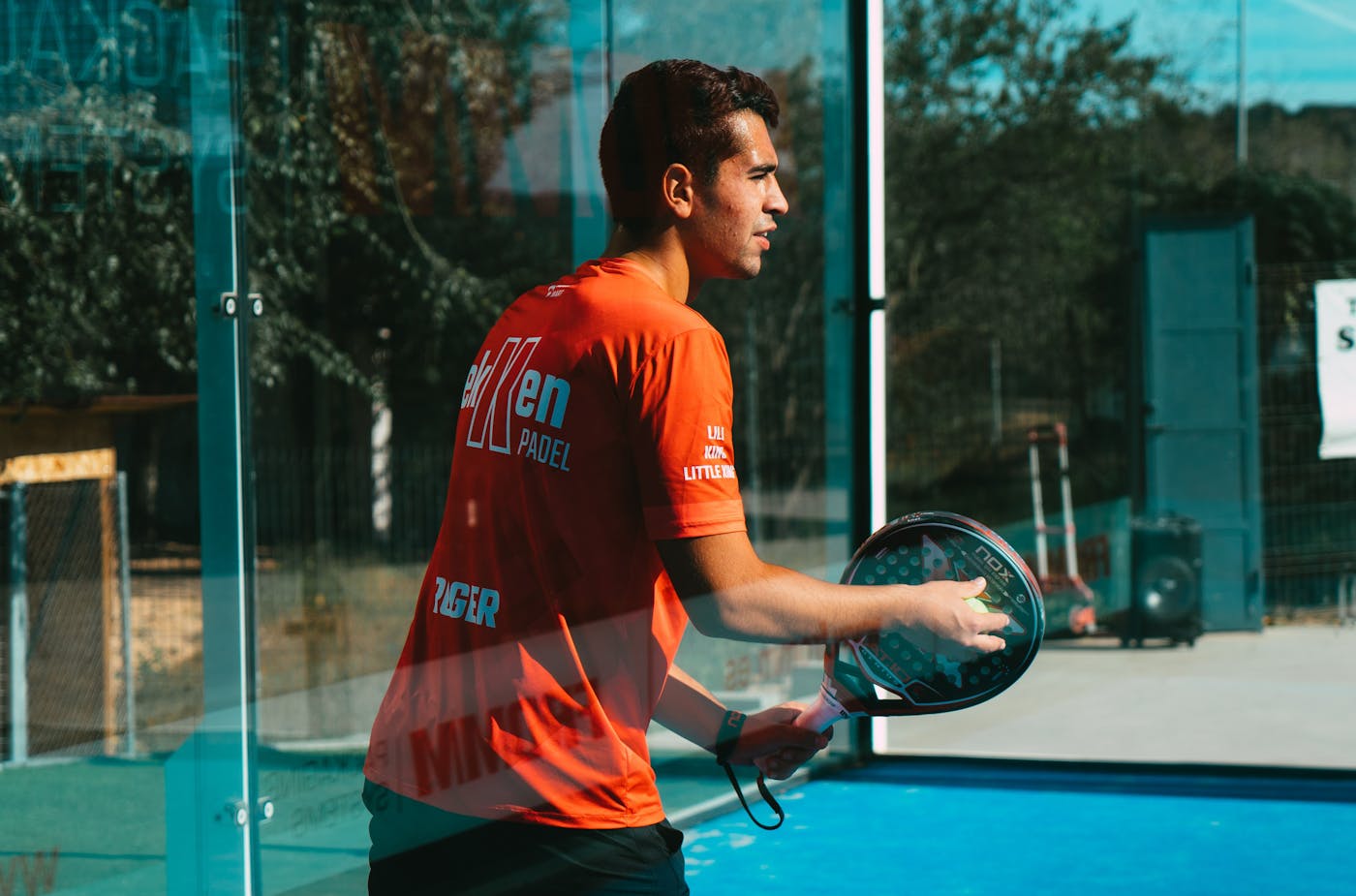
For 12 players on three padel courts, run three rounds of doubles with four people on each court and a new partner each round. The schedule below has 36 player appearances and 18 distinct partnerships: every player plays in every round and has three different partners. Opponents may repeat.
This is a practical format for a club social or a group of friends with broadly compatible experience. It is an example format, not an official tournament format. Allow roughly an hour if court availability and the pace of play permit; explain the plan before starting, and adapt the number of points if the booking is shorter.
The three-round rotation
Assign each person a number from 1 to 12. In each cell, the two numbers before “v” are partners and play against the two after it.
| Round | Court 1 | Court 2 | Court 3 |
|---|---|---|---|
| 1 | 1 + 2 v 3 + 4 | 5 + 6 v 7 + 8 | 9 + 10 v 11 + 12 |
| 2 | 1 + 3 v 5 + 7 | 2 + 4 v 9 + 11 | 6 + 8 v 10 + 12 |
| 3 | 1 + 4 v 6 + 9 | 2 + 5 v 8 + 11 | 3 + 10 v 7 + 12 |
Before starting a round, check that each court has the four listed players. This schedule guarantees distinct partners, not equal opposition, equal court assignments or a complete round robin. For two courts and eight players, use our separate eight-player Americano rotation.
How does scoring work?
For this social example, play 16 rally points per match. Each rally is worth one point. A pair might finish 10–6; both players on the winning pair each record 10, and both opponents each record 6. Players then add their own scores across the three rounds. The highest total leads the individual table.
A match can finish 8–8. Keep that result; do not invent an extra point because each round needs the same 16-point total. If players are tied on the final individual total, share the placing. If you need a sole winner, announce a tie-break procedure before the event; this sample does not rely on one.
| Player | Round 1 | Round 2 | Round 3 | Total |
|---|---|---|---|---|
| 1 | 10 | 7 | 9 | 26 |
These scores are illustrative, not results from an actual event. The maximum individual total is 48. Record both pair scores after each match and check that they add to 16; this catches common scorecard errors.
Who serves and receives?
At the start of each round, the four players agree which pair serves first and each pair selects its first server and receiving sides. For this example, the opening server serves four points, then a player from the other pair serves four, then the opening server’s partner serves four, then the remaining player serves four. Within each four-point block, start on the server’s right and alternate sides after each completed point. The receiver is diagonal to the server and the receiving partners alternate points.
This four-point block is a house format for this social session, not the standard FIP game or tie-break serving sequence. Keep the ordinary serve mechanics and court rules unless the group has agreed another suitable practice variation: the 2026 FIP Rules of Padel explain the diagonal serve and return. Our serve-rules guide covers the bounce, service box and faults.
If you prefer standard games rather than this point format, agree a scoring and time limit in advance and use the applicable serving order; the 16-point scorecard above will no longer fit automatically.
Host checklist
- Before play: confirm 12 players, three courts, balls, racket availability and the session end time. Share the rotation and decide how to handle a late arrival before the first round.
- At each change: collect scores, check their totals and direct players to the next court. Allow time for players to move safely.
- For a late arrival or early departure: pause and agree a substitute or adjustment. The fixed schedule’s equal-play and different-partner guarantees no longer apply automatically after a substitution.
- At the finish: add individual totals and share the placing for a tie. Encourage players to agree a simple middle-ball call with each new partner; our first-match partner plan has a short conversation checklist.
Players can use Padel Coach App to log a session or review a suitable clip afterwards. Ask everyone appearing for permission and follow the venue’s rules before recording; the recording guide covers framing and consent.
Learn how our guides are researched, prepared and checked in our editorial policy.